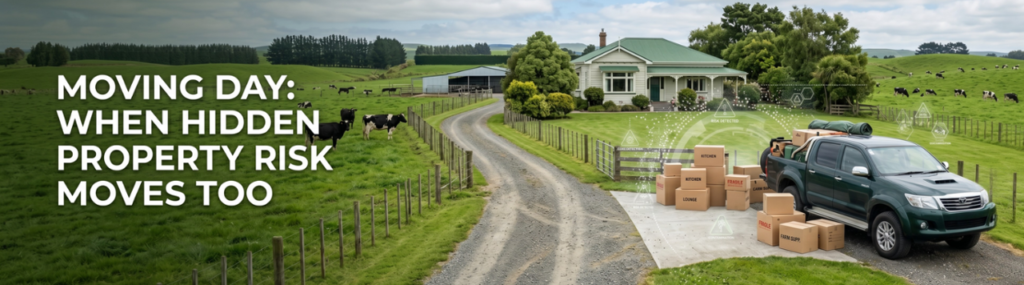
Every year on June 1st, thousands of people connected to New Zealand’s dairy industry relocate as part of the new dairy season.
Homes change occupants.
Farm workers move regions.
Contract and share milkers take over new operations.
Farming operations relocate families, staff, equipment, and sometimes entire herds.
And contracts are drawn up that apportion responsibility for property assets, with everything falling under regulation from workplace health and safety to residential tenancy law.
For the dairy industry, this movement is normal. It is part of the rhythm of the sector and the progression pathway that has shaped rural New Zealand for generations.
But while the focus is often on livestock, machinery, farm management contracts, and staffing, another part of the transition can easily be overlooked:
The condition and history of the houses in which the people associated with the farming operation will live, and who has contractual responsibility for these.
Even though these are the places where people live and families will be raised, the condition of these homes is typically secondary to the day-to-day operational considerations of the farming business.
And too often, this means hidden risks and liabilities are not considered and accounted for. As a result, when things like meth contamination are present, risk can transition to new occupants and, where the management contract provides, the new operator.
Meth use in rural New Zealand
Meth use is a problem throughout the country. The best independent measure of the extent of meth use is the quarterly wastewater statistics released by NZ Police.
What testing consistently shows is high per capita use in rural New Zealand (https://www.shhsolutions.co.nz/wastewater-testing-meth-risk-nz-property/). What these results do not show is testing from on-farm wastewater systems. So, use levels will be underestimated.
For many in the rural sector, this will be independent verification of what they already know or sense. What too few people do is join the dots between what they know is happening in their communities where meth-related behaviour is concerned, and the potential for this to translate into contaminated property that they then take responsibility for.
Taking on an unknown and unquantified risk may have serious consequences for the new operator.
For the farm owner who brings a new operator onboard, it may also mean assuming risk and liability for contamination caused by the meth habits of those who come onto the farm.
The Sharemilking Model Creates Regular Property Transition
New Zealand’s dairy industry is built on movement and progression.
Many workers begin in:
- farm assistant,
- herd manager,
- or employee roles,
before progressing into:
- contract milking,
- lower-order sharemilking,
- and eventually larger operational or ownership responsibilities.
Each step often involves relocating to a different farm and different accommodation.
That means rural housing can experience:
- frequent occupancy change,
- rotating staff,
- varying living arrangements,
- and changing responsibility between owners, operators, and workers.
Unlike standard residential tenancies, these transitions can happen quickly and under significant operational pressure.
Moving Day is not simply a house move.
It is often:
- a business transition,
- a staffing transition,
- and a property handover,
all occurring at once.
Why Rapid Property Transition Increases Risk
When properties change occupants quickly, practical risk management can sometimes take a back seat to operational urgency.
People are focused on:
- moving stock,
- coordinating transport,
- setting up new farms,
- managing children and schools,
- and preparing for the new season.
In that environment, property condition can become something that is assumed rather than properly documented.
This creates risk because hidden issues are not always obvious during a fast-moving transition.
A property may:
- look tidy,
- appear functional,
- and seem well maintained,
while still carrying an unknown history.
And once new occupants move in, separating historical issues from current ones becomes significantly more difficult.
Meth Contamination Is Often Invisible
One of the biggest challenges with meth contamination is that it frequently cannot be identified through visual inspection alone.
There may be:
- no obvious damage,
- no strong odour,
- and no visible indicators.
Yet residue can still remain on surfaces and within the property environment at levels that mean obligations under the Health and Safety at Work Act 2015 and under the Residential Tenancies (Managing Methamphetamine Contamination) Regulations 2026 are breached the moment people move in.
That means assumptions based purely on appearance can create uncertainty, risk, and liability later.
This becomes especially important during Moving Day, where incoming occupants may inherit a property without clear evidence of its prior condition, and new occupancy can introduce new risk if meth-related behaviour occurs after handover.
The Difficulty of Reconstructing History Later
Once occupancy changes, questions can become difficult to answer with confidence as to where responsibility for contamination lies.
For example:
- Was an issue already present before takeover?
- Did contamination occur recently or historically?
- Was the property ever screened previously?
- Was there documentation at the point of handover?
Without baseline evidence, these questions can quickly become disputes rather than facts.
For incoming operators, sharemilkers, and farm owners taking responsibility for accommodation, uncertainty around prior meth contamination can quickly become a liability issue if the status of the property was never properly established before takeover.
This is particularly relevant in rural environments where:
- accommodation may house different workers over time,
- properties may be managed informally,
- and multiple parties may have had access to the home.
The longer uncertainty remains unresolved, the harder it becomes to establish a clear property history.
Why Preparation Before Moving Day Matters
The most effective risk management usually happens before responsibility for the property changes hands.
For farm owners, sharemilkers, contract milkers, and accommodation providers, preparation before Moving Day can help create clarity around:
- property condition,
- occupancy transition,
- and responsibility at the point of handover.
This is not about suspicion or unfairly targeting rural communities. However, like every part of New Zealand society, the rural sector is not isolated from methamphetamine-related behaviour and the property risks that can follow it.
It is about recognising that evidence is easier to establish before a property changes hands than after questions arise later.
Simple preparation steps may include:
- documenting the condition of accommodation,
- photographing key areas,
- recording maintenance issues,
- checking smoke alarm compliance,
- and, where appropriate, arranging baseline meth screening.
These steps help create a clearer picture of the property at a specific point in time.
Rural Housing Often Operates Differently
Rural accommodation does not always follow the same systems seen in urban property management.
Some housing arrangements may be:
- tied to employment,
- managed directly by farm operators,
- occupied seasonally,
- or transferred quickly between workers and families.
This can reduce the amount of formal documentation captured during occupancy changes.
That does not mean the system is wrong.
But it does mean the importance of practical evidence becomes even greater during transition periods like Moving Day. Significantly, it does not alter the accommodation provider’s obligations at law.
The Cost of Assumption
One of the most common property risk issues is not contamination itself.
It is assumption.
Assuming:
- the property is fine,
- the previous occupants left no issues,
- somebody else checked it,
- or concerns will become obvious if they exist.
Unfortunately, hidden property risks rarely announce themselves clearly.
And once uncertainty exists, it can affect:
- future occupants,
- owners,
- operational relationships,
- insurance discussions,
- and property decisions later on.
Whether that accommodation provider is the farm owner or farm operator will be determined by the contract that is put in place between the parties. If the realities of the risk presented by meth-related behaviour have not been considered when that contract has been drawn up, parties who have had no involvement in meth-related behaviour may still find themselves exposed to legal, contractual, or operational consequences if responsibility was not clearly managed.
Moving Day Is Ultimately About More Than Logistics
Moving Day represents one of the largest coordinated transitions in New Zealand.
It reflects the strength, mobility, and adaptability of the dairy sector.
But alongside the movement of people, stock, and equipment, there is also a transfer of responsibility for the properties involved.
The most effective transitions are not only operationally successful.
They are also supported by clear evidence, good documentation, and practical preparation.
Because when property history is uncertain, the risk does not always leave with the previous occupants.
Sometimes, it stays quietly attached to the property itself.
How to mitigate risk?
At the end of the day, the decisions people make as to whether or not they find out if their new farming arrangements will expose them to the hazards associated with meth-related behaviour come down to their appetite for risk.
Finding out if problems already exist is easy and comparatively low cost. A screening assessment undertaken by a suitably qualified and experienced person is the best way to determine the meth status of a property.
Problems can be avoided before people move in, and harm is minimised.
The results also act as a benchmark for moving forward. So, if additional meth-related behaviour occurs, this will be identified. Not only does this help to manage on-farm meth-related behaviour, it establishes a defensible position moving forward.
Contact us to discuss your circumstances and how we can help.