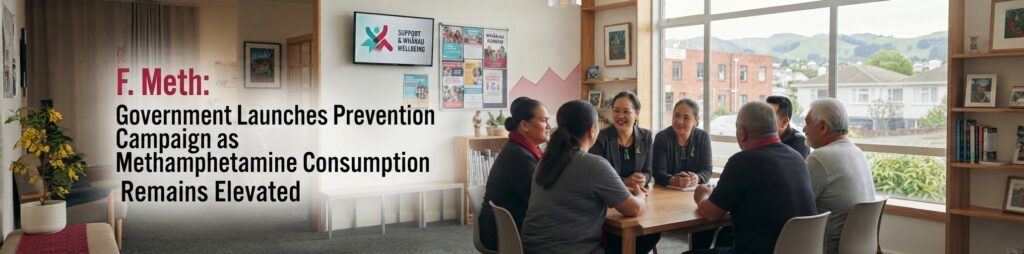
Just ten days after wastewater data revealed that New Zealand consumed an estimated two million doses of methamphetamine in a single week in April 2026, the Government has launched its long-awaited national prevention campaign, F. Meth.
The $1.584 million, six-month campaign — funded from the Proceeds of Crime Fund — forms part of the $30.6 million health-led package announced in November 2025. It will run across social media, online video, digital screens, posters, radio, digital audio, and community channels, with an expected reach of more than 2.5 million New Zealanders aged 18–59.
A Shift Toward Demand Reduction
Mental Health Minister Matt Doocey was clear about the intent:
“Meth causes enormous harm to individuals, families and communities, and we know we need to do more to reduce demand by stopping people from starting in the first place.”
The campaign is deliberately blunt. The slogan “F. Meth” is designed to be open to interpretation – fight meth, face meth, forget meth, be free from meth harm or something a little more industrial in terms of language – while remaining direct about the drug’s impact. It has been shaped by community and lived-experience input and will be formally evaluated after six months before any further rollout.
This marks a notable evolution in the Government’s approach. While the original Action Plan emphasised enforcement and supply disruption, F. Meth represents the first major national investment in visible, broad-reach demand reduction messaging since consumption began its sharp rise in mid-2024.
How This Fits the Data
The timing is significant. The wastewater figures discussed on Newstalk ZB on 7 September showed New Zealand’s methamphetamine consumption had increased by 139% between 2023 and 2026 — dramatically outpacing Australia’s 23% rise over the same period. The data also suggested that existing users were consuming more frequently, raising the risk of dependence.
F. Meth directly targets this demand-side challenge. By aiming to build confidence and refusal skills before use becomes habitual, the campaign attempts to address the very pattern the wastewater results highlighted.
However, as the original analysis noted, criminal enforcement measures were relaxed before the marked upward trend. Criminal enforcement measures have not been replaced with any form of compulsory civil consequences. The arrival of this prevention campaign is therefore welcome, but its effectiveness will depend on whether it can generate the kind of cultural and personal resistance needed to meaningfully shift behaviour, where that behaviour shift is voluntary.
Community-Led Approach
The campaign was launched in Porirua alongside the Resilience to Organised Crime in Communities (ROCC) programme, signalling an intent to work with — rather than replace — existing local efforts. Health New Zealand has encouraged iwi, community organisations, sports clubs, and workplaces to adapt the resources for their own contexts.
This aligns with the view that sustainable change is more likely when communities lead the response. The campaign explicitly positions itself as “one prevention tool within a much wider health response,” alongside initiatives such as Pou Whānau Navigators, expanded peer and family support, and school-based programmes like Tūturu. How that wider health response evolves remains to be seen.
Thoughts to Ponder
The launch of F. Meth is a positive and necessary step. After years of platitudes with any efforts to tackle meth-related harm being focused on demand-side, enforcement-focused policy, a visible national prevention campaign that speaks directly to individuals and whānau who are directly affected by meth is long overdue.
It is encouraging to see growing recognition by government that methamphetamine is not just a serious and widespread issue, but one that needs investment in demand reduction – even if many voters still do not yet fully appreciate the scale of the problem.
That said, several questions remain:
- Will a six-month campaign, even with strong creative execution, be sufficient to shift entrenched patterns of use?
- How will the campaign’s impact be measured beyond reach and recall — particularly in relation to actual reductions in consumption or help-seeking behaviour?
- Can prevention messaging alone create the external motivators needed when brain chemistry and social pressures are so powerful?
- Is an investment equivalent to around the same amount of money being spent each week on meth in this country enough?
The regulatory environment around methamphetamine in rental properties – where the majority of meth-related activity occurs – also remains unchanged. The 15 µg/100 cm² threshold continues to sit well above international reference levels, and the research recommended in the 2018 Gluckman report has still not been completed. These regulatory changes enshrine in law the mindset of many people whose meth use began in 2018: that using meth in homes is acceptable. In relation to these changes, the “F” should be read as “foreseeable.”
This disconnect between the scale of the problem and the regulatory settings designed to address it needs to be tackled alongside the campaign if real progress is to be made.
F. Meth gives communities another tool. Whether it proves to be an effective one will depend on both the campaign’s execution and the broader policy settings that surround it.