A recent conversation that didn’t sit right
Not long ago, I was speaking with a real estate agent during a property discussion.
The comment was casual. Confident.
“With the new meth regulations, buyers don’t really need to worry anymore — the thresholds have changed.”
At face value, it sounds reasonable.
But it’s wrong.
And more importantly — it reveals a growing misunderstanding in the market.
What has actually changed (and what hasn’t)
As of April 16, 2026, New Zealand introduced a minimum compliance framework for residential rental properties under the Residential Tenancies (Managing Methamphetamine Contamination) Regulations 2026.
That framework:
- Sets 15 µg/100 cm² as the contamination threshold
- Defines 30 µg/100 cm² as uninhabitable
- Applies only within the context of residential tenancies
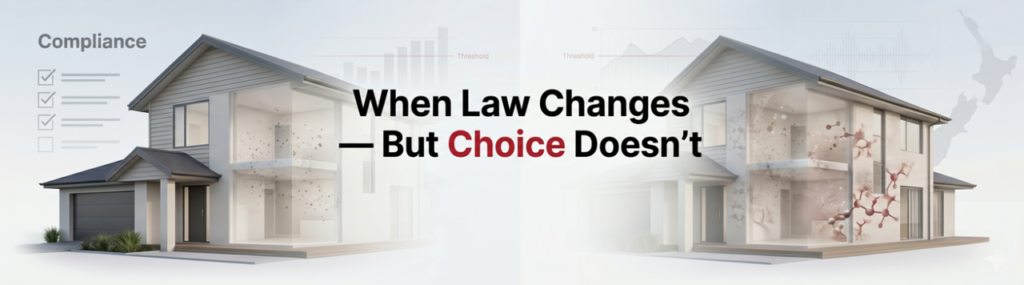
Here’s the critical point: This regulation does NOT apply to property sale and purchase.
At the same time: The internationally aligned standard — NZS 8510:2017 — has not changed.
The disconnect: compliance vs decision-making
This is where confusion is creeping in.
Some in the market are treating the new minimum compliance threshold as if it is:
- A universal safety benchmark
- A recommended exposure level
- Or worse — a “no-risk” line
It is none of those things.
It is simply: A legal minimum for managing tenanted properties — not a risk threshold for people.
Buyers still have something tenants don’t: choice
In a property transaction, buyers retain full autonomy.
They can decide:
- What level of contamination they are comfortable with
- Whether to test at all
- Whether to remediate below regulatory thresholds
- Whether to walk away entirely
There is no law forcing a buyer to accept 15 µg/100 cm².
They can set their own standard — including zero.
Landlords sit in the middle
Landlords still have some discretion — but it’s constrained.
Between tenancies:
- They can choose to follow NZS 8510:2017
- They can clean to lower thresholds if they wish
But during a tenancy:
- Termination of a tenancy is only automatically possible where there are reasons to suspect attempts at manufacture – meth contamination is over 30 µg/100 cm²
- Their options are limited unless contamination exceeds 15 µg/100 cm²
- Even when responsibility is clear, Tenancy Tribunal outcomes may prioritise tenancy continuity
This creates a tension: Ownership does not always equal control.
And tenants? They carry the outcome
This is the uncomfortable part.
For tenants:
- Termination of a tenancy is only automatically possible where there are reasons to suspect attempts at manufacture – meth contamination is over 30 µg/100 cm²
If contamination is below 15 µg/100 cm² – the property remains legally habitableWhich means: Tenants may have no ability to require remediation and no ability to exit easily based on contamination concerns
In simple terms: Once tenants move in, don’t get to choose the level — they inherit it.
Tenants who are concerned about the increasing levels of meth contamination in New Zealand rental property MUST find out about the meth status fo a property before they commit.
Why this matters more than people think
When a compliance threshold is mistaken for a safety threshold, risk doesn’t disappear.
It just becomes less visible.
We’ve effectively created three different realities:
| Group | Level of Control |
| Buyers | Full choice |
| Landlords | Partial control |
| Tenants | Minimal control |
That imbalance isn’t widely understood — but it has real consequences.
A global perspective: New Zealand is a global outlier
Looking internationally, there is no single universal threshold — and importantly, most jurisdictions recognise meth contamination as a health risk management issue, not just a compliance one.
Australia
- No unified national regulation
- Guidance developed for management of meth labs, but stated within regulations as applying to contamination form use alone, identifies 0.5 µg/100 cm² investigation levels
- Strong emphasis on risk assessment and remediation, not legal minimums
United States
- State-by-state regulation
- Common standards range from 0.1 to 1.5 µg/100 cm² with multiple states applying reference levels to contamination arising from manufacture and/or use alone
- Often tied to health-based risk frameworks
United Kingdom
- No formal national meth contamination threshold
- Managed under housing quality and environmental health laws
- Focus on case-by-case risk evaluation
So where does that leave us?
New Zealand’s new regulation has done a number of things:
- It has created clarity for tenancy management
- It has established a minimum legal baseline
- It has superseded NZS8510:2017 as the trigger for most insurance policies leaving landlords to bridge the financial gap between minimum compliance and personal expectation
But it has also unintentionally created a new risk: The perception that “legal” in terms of rental property compliance equals “acceptable” as far as tenants and prospective buyers is concerned AND is risk free as far as health and wellbeing is concerned.
Back to that conversation
That real estate agent wasn’t being careless.
They were reflecting what many are starting to believe.
And that’s exactly the issue.
Because when:
- A minimum compliance rule
is mistaken for - A decision-making framework
We start making choices based on the wrong benchmark.
The takeaway
- The law has changed — but only for residential rentals
- Property sales remain a choice-driven environment
- NZS 8510:2017 still exists, is internationally aligned (albeit at the top end of the scale of acceptability — and still matters
- And most importantly: Minimum compliance is not risk management
Final thought
If you’re buying, you still have the ability to decide what you’re comfortable with.
If you’re a landlord, you still have decisions to make — but within constraints.
If you’re a tenant, the system now decides more on your behalf than it used to.
And if you’re a property industry professional:
The responsibility isn’t just to follow the law —
it’s to understand what it does, and what it doesn’t and make sure your actions protect yourself, your company and your clients.
We are not here to catch people out. We are very much focused on making sure people do not get caught out by NZ’s growing fascination with methamphetamine. These thoughts are shared with that end in mind.