The risk didn’t increase.
It was redefined.
For years, methamphetamine contamination in residential property was often treated as an occasional issue — something associated with obvious warning signs, severe damage, or extreme cases.
But when we step away from perception and look at measured behaviour, a different reality emerges.
Over the past three years, wastewater testing across New Zealand has provided one of the clearest indicators of actual meth-related behaviour — not simply reported use, suspected activity, or the number of meth labs police resources allow to be detected, but what is actually occurring across communities.
It is one of the best independent measures of the extent of the risk posed by methamphetamine to New Zealand.
And now, with the introduction of the 2026 residential tenancy regulations, that data takes on a new meaning.
A structural shift — not a temporary spike
National wastewater data shows:
• 2023: ~12–14 kg/week
• Early 2024: ~17–18 kg/week
• Late 2024 peak: ~32–36 kg/week
• 2025: sustained at ~29–34 kg/week
This is not volatility.
This is a step change in baseline behaviour.
Even where fluctuations suggest some decline, meth-related behaviour appears to stabilise at levels more than double those seen just a year earlier.
What this means:
Methamphetamine use is persistent, embedded, and continuous within communities.
Where use occurs inside property, residue exposure can follow.
Wastewater measures behaviour — not compliance
Wastewater testing removes uncertainty.
It captures:
• What meth-related behaviour is actually happening
• Patterns across entire populations where testing can be done
• Community-level behaviour without relying on disclosure, suspicion, or reporting
Importantly, some rural areas may be underrepresented in wastewater monitoring, despite many meth-affected properties existing outside major urban centres.
Every region shows consistent meth presence.
Which means:
This is no longer a question of whether meth exists in a community — only how much, and what that means for harmful effects, including property exposure.
Regional data confirms: risk is everywhere — just expressed differently
Different regions show different forms of risk.
Regional North Island
Northland, Eastern, Waikato
• High per-capita consumption
Intensity risk — fewer properties, but higher exposure likelihood per property.
Auckland / Tāmaki Makaurau
• Highest total consumption volume
Scale risk — lower concentration, but far greater probability across housing stock.
Growth regions
Bay of Plenty, Central, Wellington
• Rapid increases since mid-2024
Spread risk — patterns converging across regions.
The takeaway:
Risk is not isolated.
It is distributed across the system.
2024: the inflection point
Across almost every region:
• Consumption increased sharply
• Patterns shifted from cyclical to sustained
• Elevated levels did not simply revert
This marks the transition from:
• episodic behaviour
to
• structural, ongoing exposure
What the wastewater signal tells us
Wastewater testing does not identify a specific property.
It does not tell us who is using methamphetamine, which home they are in, or whether an individual property is contaminated.
But it does tell us something property owners, and more importantly buyers, cannot afford to ignore:
Meth-related behaviour is embedded across New Zealand communities.
That matters because property risk follows behaviour.
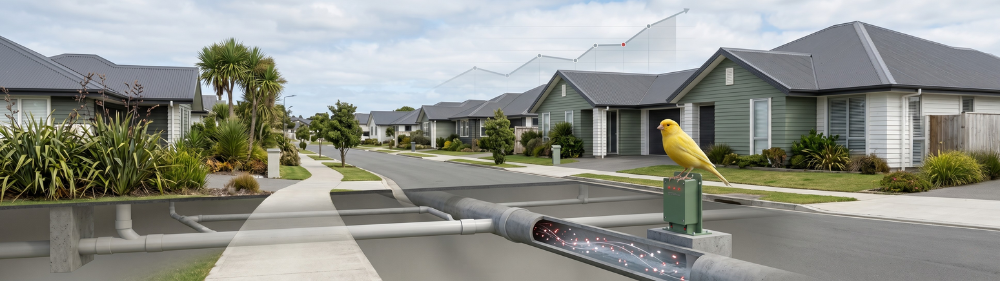
The wastewater signal is the canary in the coal mine.
It warns us that meth-related risk should no longer be treated as isolated, occasional, or obvious.
For buyers, this matters more than ever. The new regulations may have lulled some owners into believing meth risk has reduced, but wastewater testing tells a different story.
In Part 2, we look at what that signal means for property buyers and owners — especially under the 2026 minimum compliance framework.
Because while wastewater shows the behaviour, regulation now defines when consequence can be applied.